The following images are realised for the Doctoral research at the Royal College of Art, London.
The Vaginal Camera. 2020-Ongoing.
Gelatin Silver Prints
60x50 cm
Ed. of 5 + 2poa.
And Fine Art Baryta Prints.
They serve as key images for the silver prints. Both are taken at exactly the same moment.
30x40 cm
Ed of 25 + 2 poa
Nude Content Warning.
Please be aware the following images may contain nudes.
Abstract:
In a highly influential, controversial article of 1975, feminist film theorist Laura Mulvey proposed that in patriarchal society ‘pleasure in looking has been split between active/male and passive/female’. Criticised for its essentialist reading of what has since become widely known as the ‘male gaze’, which Mulvey characterised as having two modes of looking at the female body termed ‘voyeuristic’ and ‘fetishistic’, the article generated a wealth of work on the connections between gender, sexuality and spectatorship, especially in studies of time-based media, Mulvey’s original focus. While scholars have problematised Mulvey’s work for its unitary, heterosexual masculine and feminine positions, this study, returns to Mulvey’s ideas to think about how, in fact, they do articulate a lived experience within a particularly oppressive Italian culture of being looked at – namely, Berlusconi's TV. How might a photographic practice offer a way of repairing this experience, and resisting its continuation?
The thesis expands Mulvey’s questions, moving from the matter of what it means to gaze upon the female body, to the matter of what it means to have this gaze returned from the female body in the form of an image it produces itself. Conceived as an embodied, autotheoretical mode of inquiry, which underlines the importance of the artist-researcher’s body, emotions and experiences to the field of research, the practice-based project charts the development of a vaginal camera, a device inserted by the object of the gaze to invert this same gaze. How might this ‘vaginocamera’, located inside the artist-researcher’s body, which looks out at the world through the labia, provide a window on to what we photograph, and why; to the relations of power which still define the production of the image; to the sexed and gendered semiotics of the photographic image in particular; to the representation of the heterosexual, maternal body, and especially of the vulva and vagina?
Photographing her own body, her husband’s body, and friends and colleagues’, from her own body, the artist-researcher understands and values her practice as situated, as non-definitive, as experience-based, as (tender, loving) care for herself and her intimate relationships with others.The breakdown of the single perspective through the assumption of two points of view over the same event, positions the photographer in the same vulnerable/exposed spot of the model, providing the model with the comfort of an equitable exposure with the photographer.

Draughtsman Making a Perspective Drawing of a Reclining Woman, Durer, 1600 ca.
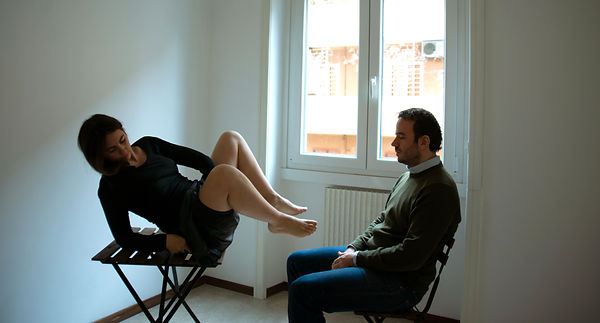
Dafne taking a vaginal portrait of their husband Davide. 2021

Davide. 2021

Vera, 2022.

Key Picture of Vera, 2022.

Sara, 2022.

Key picture for Sara, 2022.

Giuliana, 2022.

Key picture for Giuliana, 2022.

Dafne seen from Giuliana, 2022.

Key picture for Dafne seen from Giuliana, 2022.

Francesca, 2023.

Key picture for Francesca, 2023.

A Friend, 2023.

Key picture for my friend, 2023.

Self-portrait, 2020.

Key picture for Self-portrait, 2020.

Self-Portrait, 2020.

Self-Portrait, 2021.

Pregnant Self-Portrait, 2023.

Key picture for Pregnant Self-Portrait, 2023.

Pregnant Self-Portrait, 2023.

«Scrivere infatti è parlare dal profondo grembo materno» scrive Ferrante in I giorni dell’abbandono.
Cosa succederebbe se invece di parlare dal profondo del mio utero scattassi fotografie? Prima di rimanere incinta nel 2015, non ero consapevole della mia anatomia fino in fondo. Quel taglio nel corpo, la vulva, complica la percezione di un corpo chiuso e della sua integrità, della sua identità. I suoi confini e limiti devono essere ripensati al di fuori della metafisica dualista – binaria - occidentale. Una vulva complica la percezione di ciò che è interno e ciò che è esterno, rilascia fluidi ed esseri umani.
Partendo dal concetto del Male Gaze di Laura Mulvey, e seguendo le successive teorie femministe e gli studi di genere, la mia ricerca mira a comprendere quali siano le implicazioni di scattare foto con la vagina, utilizzando letteralmente l’oscurità del corpo come camera oscura. Inserendo la pellicola all’interno della vulva e facendo entrare la luce, la pellicola restituisce un’immagine. Io sono la macchina fotografica che scatta le foto, ribaltando i tradizionali ruoli di potere e rivendicando la soggettività rispetto all’atto di guardare.
‘To actually write is to speak from the deep maternal womb’ writes Ferrante in I giorni dell’abbandono. What if, rather than speaking, I was taking pictures from the deepness of my uterus? Before getting pregnant, I wasn’t aware of my body’s physiology. That cut in the body, the vulva, which complicates the perception of a closed body, its integrity. Its boundaries and limits have to be rethought outside the western dualistic metaphysic.A vulva complicates the perception of external and internal. It leaks fluids and human beings.
Following feminists’ theories and gender studies, my research aims at understanding what are the implications of taking pictures with the vagina, literally utilizing the darkness of the body as a camera obscura. Inserting the film inside the vulva and by letting the light in, the film returns an image. I am the camera taking the pictures, reclaiming subjectivity and agency over the act of looking.


